Florida voters approved Amendment 3 on November 3, 2026, giving it 61.98% Yes in early, unofficial results, above the 60% it needed to pass. The state is scheduled to make the results official on November 17, 2026.
If your home is your primary residence, Amendment 3 will likely lower your property taxes beginning with your 2027 bill. Although many homeowners will see the same dollar savings, owners of lower-value homes will save a much larger share of their tax bill.
The information provided in this website was derived from sources deemed to be reliable but is not guaranteed or warranted. All information, content, and materials available on this site are for general informational purposes only and are not intended to be legal, financial or tax advice. The information contained herein is not a substitute for professional legal, financial, or tax consultation and should not be relied upon for any legal, financial, or tax matters. If you require legal, financial or tax assistance, please consult with a qualified attorney, financial or tax professional who can provide guidance tailored to your specific situation.
What Amendment 3 changes
Florida’s homestead exemption takes part of your home’s value off the tax rolls, and it applies only to your primary home, the place where you live full-time and have filed for homestead. Under the official ballot text, the exemption for county and local taxes grows to $150,000 in 2027 and $250,000 in 2028, and after that it rises with inflation.
These new amounts replace today’s exemption rather than being added on top of it. Today, the exemption takes up to $51,411 off your home’s value for county and local taxes and $25,000 off for school taxes.
School taxes, however, still get only the $25,000 exemption, and fees on your tax bill, such as trash pickup or drainage, are not reduced.
Amendment 3 also affects homes that are not anyone’s primary residence, such as rentals and second homes. For county and local taxes, the value the county uses for those homes can currently rise as much as 10% a year, and starting in 2027 that limit drops to 5%. The lower limit slows future increases but does not cut today’s bill or limit tax rates, and a sale or change in ownership can still reset the value to market value.
If you were not a Florida resident on December 31, 2026, you will start with today’s smaller exemption and move to the larger one in your fifth year, provided that rule holds up under the U.S. Constitution. Your 2026 bill stays the same, and the Palm Beach County Property Appraiser says you will first see the change on your August 2027 TRIM notice (the proposed tax notice mailed each August) and your November 2027 tax bill.
The three values on your tax notice
For property tax purposes, your home carries three different values:
- Market value is what your home would likely sell for, which the county calls “just value.”
- Assessed value is the value the county uses for taxes, and as long as you keep your homestead, Florida’s Save Our Homes rule keeps it from rising more than 3% a year, or the inflation rate if that is lower.
- Taxable value is the part of your home’s value that is actually taxed once exemptions are subtracted.
If you have owned your home for many years, its assessed value may be far below its market value, so a low assessed value does not mean a low income or an inexpensive home.
Why lower-value homes save a larger share
Because the new exemption is a set dollar amount rather than a lower tax rate, every homeowner whose assessed value is high enough receives the same additional exemption of $98,589 in 2027 and $198,589 in 2028. The dollar savings are therefore the same whether the assessed value is $400,000 or $2 million.
Lower-value homes reach a floor, since their taxable value for county and local taxes can drop to $0 and their savings stop there. Those dollars are still a much bigger slice of a smaller bill, although even at $0 you still pay school taxes and fees.
Examples of what you might save
The examples below use a home in unincorporated Palm Beach County, outside city limits, where the 2026 tax rate is $16.2192 for every $1,000 of taxable value, made up of $9.9322 for county and local services and $6.2870 for schools. Because your rate depends on where you live, you can estimate your own savings with the Property Appraiser’s calculator.
| Assessed value | Taxed today | Taxed in 2027 | Taxed in 2028 |
|---|---|---|---|
| $150,000 | $98,589 | $0 | $0 |
| $250,000 | $198,589 | $100,000 | $0 |
| $400,000 | $348,589 | $250,000 | $150,000 |
| $600,000 | $548,589 | $450,000 | $350,000 |
| $1,000,000 | $948,589 | $850,000 | $750,000 |
| $2,000,000 | $1,948,589 | $1,850,000 | $1,750,000 |
| Assessed value | Yearly tax today | 2027 savings | 2027 % cut | 2028 savings | 2028 % cut |
|---|---|---|---|---|---|
| $150,000 | $1,765.08 | $979.21 | 55.5% | $979.21 | 55.5% |
| $250,000 | $3,387.00 | $979.21 | 28.9% | $1,972.43 | 58.2% |
| $400,000 | $5,819.88 | $979.21 | 16.8% | $1,972.43 | 33.9% |
| $600,000 | $9,063.72 | $979.21 | 10.8% | $1,972.43 | 21.8% |
| $1,000,000 | $15,551.40 | $979.21 | 6.3% | $1,972.43 | 12.7% |
| $2,000,000 | $31,770.60 | $979.21 | 3.1% | $1,972.43 | 6.2% |
These tables are examples only, with amounts rounded and fees such as trash pickup left out.
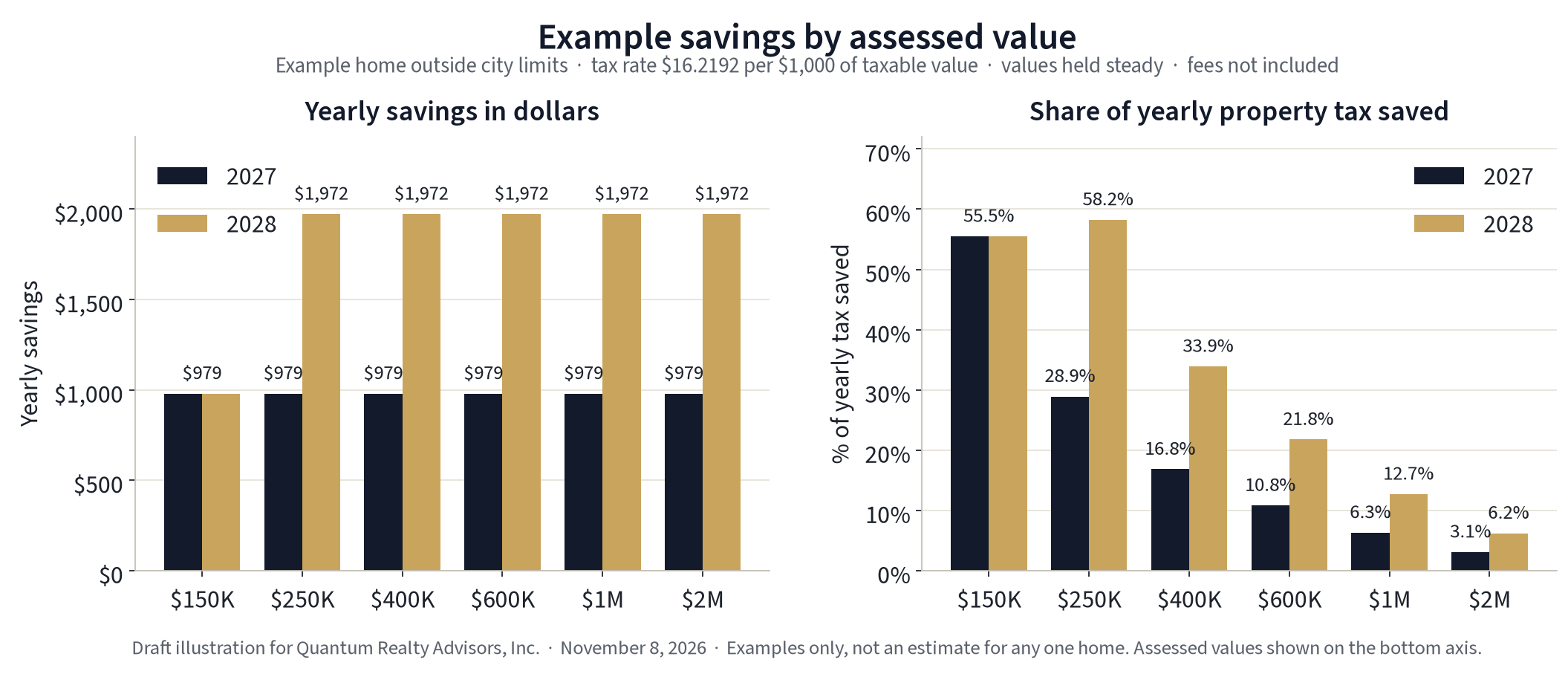
At $150,000 of assessed value, county and local taxes drop to $0 in 2027, and the yearly tax falls from $1,765.08 to $785.88, a 55.5% cut. The remaining $785.88 is school tax, and fees are extra.
From $250,000 and up, the 2028 savings are the same $1,972.43, but the share of the bill saved shrinks as value rises, falling from 58.2% at $250,000 to 6.2% at $2 million.
What the County Numbers Tell Us
You may see a figure of 210,369 Palm Beach County homes. That is the number of homestead properties with a taxable value under $250,000 on the 2026 county tax roll, out of 662,126 properties in all, and it is not the number of homes that will pay no property tax.
Because taxable value already has today’s exemption taken out, many of those homes have an assessed value above $250,000 and will still owe some county and local tax in 2028. A closer count is the 169,600 homesteads with an assessed value under $250,000, and even those homes will still owe school taxes and fees. About 11,878 homesteads already show $0 county taxable value and still receive a bill. These counts refer to properties, not people or incomes.
What this means for retirees and lower-income homeowners
Owning a home costs much more than it did a few years ago, and property taxes are only part of the picture:
- Average Florida homeowners insurance premiums rose about 26% for houses and 56% for condo units from early 2021 to late 2024, according to state data compiled by FIU.
- Florida’s 2022 condo safety law requires many buildings to save more for major repairs, and in nearby Miami-Dade, average monthly condo fees rose from $572 in 2021 to $847 in 2025, about 48%, an FIU study found.
- Repair costs are higher too, with prices for home building materials rising about 41% from 2019 to 2025, federal data shows.
For many retirees, income has not kept up with these costs. Social Security raises added up to about 25% from 2020 through 2025, followed by 2.8% for 2026 and 3.6% for 2027, and for anyone living on a fixed income, each new bill means cutting back somewhere else.
For these owners, Amendment 3 can bring welcome relief. If your home has a fairly low assessed value, most or all of your county and local property taxes could go away. In our examples, a homestead assessed at $150,000 saves about $979 a year, and one assessed at $250,000 saves about $1,972 a year by 2028, money that could help cover insurance, fees or repairs.
Your bill will not disappear, since you will still pay school taxes and fees such as trash pickup. Even so, a smaller tax bill can make it easier to stay in your home, although it does not make it cheaper to buy a different one.
The tax break is not based on income. Because of Save Our Homes, a long-time owner of an expensive home can also have a low assessed value, so the larger percentage cut is not aimed only at people with lower incomes.
Renters do not receive the homestead exemption, and while landlords may see slower tax growth under the new 5% limit, nothing requires them to pass those savings on to tenants.
Amendment 3 also does not build new homes or set home prices. Lower taxes could lead some buyers to pay more for homes and push prices up, although that may not happen.
Families inheriting a parent’s home should check whether the homestead exemption carries over, because losing it can sharply raise the tax bill.
What it means for local governments
What homeowners save means less money for county, city and other local budgets. Florida’s official revenue forecasters put the cost for all 41 local taxing governments in Palm Beach County at about $418 million in 2027 and about $779 million a year by 2028. The 2028 number is the yearly total by then rather than an extra amount on top of 2027, and it reflects both the larger exemption and the 5% limit. School taxes and fees are not reduced.
Measured against the property taxes billed in the county in 2026, that is about 6.6% in 2027, rising to about 12.3% in 2028, or about 6.1% and 11.3% if fees are counted as well. These are estimates based on 2025 data rather than promised cuts, and local governments could also change tax rates or fees later.
How we figured these examples
These figures are examples, not estimates for any particular home. They assume a full-time Florida resident who already has homestead as of December 31, 2026, receives only the standard 2026 exemptions and keeps the same assessed value, with a total 2026 tax rate of $16.2192 per $1,000 of taxable value ($9.9322 county and local, $6.2870 school). We left out fees, other exemptions and any future rate changes, with full tax-rate details listed under Sources.
Frequently asked questions
Sources
We checked these sources on November 8 and 9, 2026.
- Florida Division of Elections: Amendment 3 results (unofficial)
- Florida Division of Elections: certification timeline
- Florida Department of State: Amendment 3 ballot text
- Florida Department of State: Amendment 3 initiative page
- Florida Revenue Estimating Conference: local revenue estimate (July 10, 2026)
- Florida Department of Revenue: 2026 homestead exemption amount
- Palm Beach County Property Appraiser: Amendment 3 calculator and FAQ
- Palm Beach County Property Appraiser: Save Our Homes and assessment limits
- Palm Beach County Property Appraiser: 2026 final tax rates
- Palm Beach County Property Appraiser: 2026 certified tax roll data
- FIU Metropolitan Center: Florida condo and homeowners insurance premium increases, 2021–2024 (Florida Office of Insurance Regulation data, 2025)
- FIU Metropolitan Center: Determinants of condominium association fees, Miami-Dade (November 2025)
- U.S. Bureau of Labor Statistics: Producer Price Index, inputs to residential construction, goods
- Social Security Administration: cost-of-living adjustments (2026 and 2027)
Cost figures: insurance changes are average premiums from Q1 2021 to Q4 2024 (house figure is the non-condo owners category); Miami-Dade condo fees are averages for units sold under $1 million, not adjusted for inflation; the 41% repair figure compares 2019 and 2025 annual averages of a producer price index for building materials and does not include labor; Social Security raises compound the January 2020 to January 2025 adjustments.
Tax-rate detail for the examples (2026 final rates per $1,000 of taxable value, unincorporated area): Palm Beach County 4.5000; county debt service 0.0210; Fire Rescue 3.4581; Library 0.5491; Children’s Services 0.4908; Health Care District 0.6561; South Florida Water Management District 0.0948; Okeechobee Basin 0.1026; Everglades Construction 0.0327; Florida Inland Navigation District 0.0270 (county and local total 9.9322). School Board state 3.0390 and local 3.2480 (school total 6.2870). Current-law exemptions: $25,000 on all taxes plus up to $26,411 more for county and local taxes on assessed value above $50,000. County counts and 2026 totals ($6,310,423,382.44 in property taxes and $573,744,672.83 in fees; $6,884,168,055.27 combined) were calculated from the Property Appraiser’s published 2026 certified roll files. Exact state estimates: $418,126,098 (2027) and $778,833,069 (2028).